Post-quantum encryption
Why data you store today must be encrypted against tomorrow's quantum computers — and how KerPlace does it.
Harvest now, decrypt later
Most secure systems exchange keys using mathematics (RSA, elliptic curve) that is hard for ordinary computers but easy for a large quantum computer. Those machines don’t exist yet — but an adversary does not need to wait. They can copy your encrypted data today from a stolen disk, a leaked backup or a tapped link, and keep it until a quantum computer can open it. For anything that must stay secret for years, yesterday’s encryption is already insufficient.
What quantum computers break — and what they don’t
| Used for | Examples | Quantum-safe? |
|---|---|---|
| Key exchange (“asymmetric”) | RSA, elliptic curve | No — broken |
| Bulk data (“symmetric”) | AES-256 | Yes — stays strong |
The weak link is how keys are protected, not the cipher that scrambles the bytes. That is exactly the link KerPlace upgrades.
KerPlace’s approach: hybrid envelope encryption
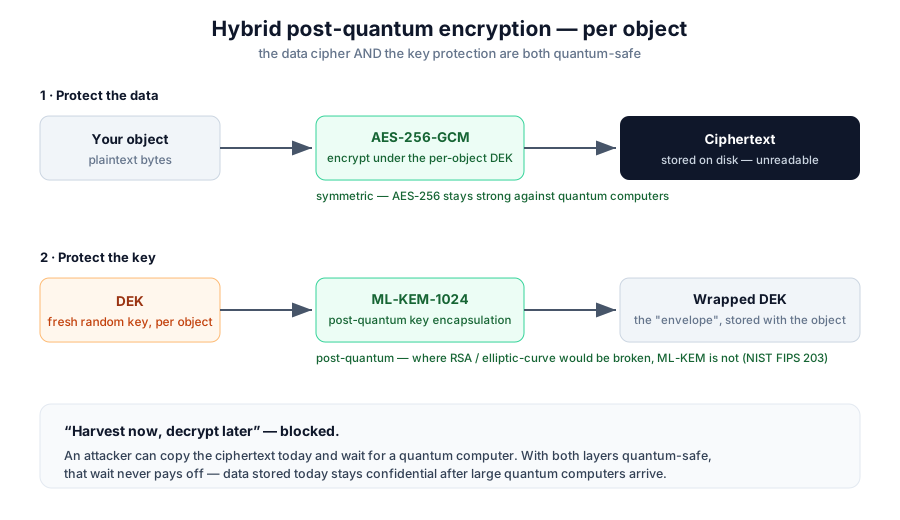
For every object:
- A unique random data key is generated for that object.
- The bytes are encrypted with AES-256-GCM (fast, hardware-accelerated, quantum-safe at 256 bits).
- The data key is protected with ML-KEM-1024 — the post-quantum standard published by NIST in 2024 (FIPS 203). The protected key travels and rests as an “envelope”.
Both layers — the cipher over the data and the mechanism over the key — are quantum-resistant. Data harvested today stays unreadable after large quantum computers arrive.
Who needs it
Health, legal, financial and government records; identity documents and credentials; long-lived backups and archives — anything whose confidentiality must outlast the arrival of quantum computing. KerPlace applies it to every object by default.
Full detail, source & scripts in the repository → https://github.com/agalletero/kerplace/blob/main/docs/POST_QUANTUM.md